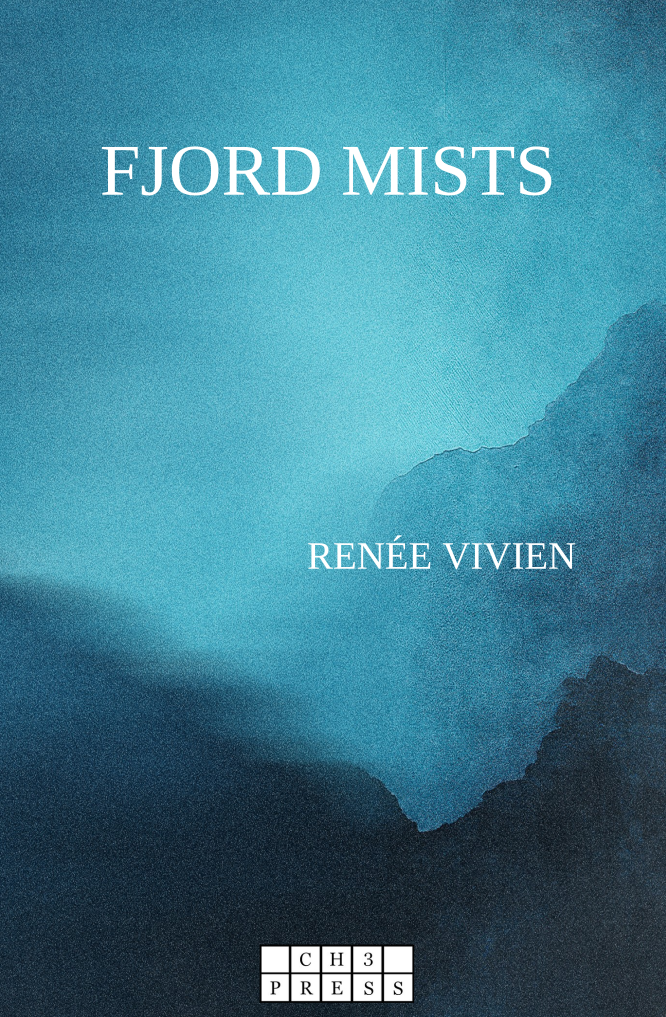
Fjord
Fjord Mists
Renée Vivien
ISBN: 978-2-487404-19-9
ebook 5 euros
Also available via major retailers like Barnes & Noble, Bookshop.org...
She was known as the Muse of Violets and died at thirty-two, in 1909. Today, the name Renée Vivien still circulates less as a body of texts than as a constellation of images: Natalie Barney, Liane de Pougy, Colette; the early twentieth century with its diaphanous dresses and heavy jewellery, moonstones, languor, and cultivated melancholy. The Belle Époque has preserved her as a silhouette, a figure of style.
What has not been preserved with equal care are her poems. They are rarely taught, seldom quoted, and often remembered only through the legend that has grown around them. Even the basic facts are obscured. Renée Vivien was born Pauline Tarn in 1877, an English child who rejected her country, her language, and eventually her given name. The pseudonym she adopted almost casually would come to eclipse the work it was meant to sign.
EXCERPT:
The Profane Genesis
I. — Before the Universe's birth, two eternal principles existed: Jehovah and Satan.
II. — Jehovah embodied Power; Satan embodied Deception.
III. — And the two great principles detested each other with intense hatred.
IV. — In that time, Chaos reigned.
V. — Jehovah declared, “Let there be light.” And light appeared.
VI. — And Satan devised the mystery of night.
VII. — Jehovah breathed upon the immensity, and from His breath the Sky was born.
VIII. — Satan veiled the unyielding blue with the transient grace of clouds.
IX. — From Jehovah's labouring hands, springtime emerged.
X. — But Satan envisioned the gloom of autumn.
XI. — Jehovah created the strong and slender forms of animals.
XII. — Beneath Satan's furtive smile, flowers burst forth.
XIII. — Jehovah shaped clay. And from that clay he crafted Man.
XIV. — From the very essence of that idealised flesh, the flesh of Woman, the work of Satan.
XV. — Jehovah subjected man and woman to violence and the embrace.
XVI. — Satan imparted to them the sharp subtlety of the unholy caress.
XVII. — Jehovah formed the soul of a poet from his breath.
XVIII. — He inspired the Ionian Aede, mighty Homer.
XIX. — And Homer celebrated the splendour of carnage and the glory of spilled blood: the ruin of cities, the sobbing of widows, devouring flames, the flash of swords, and the clash of battles.
XX. — Satan inclined towards the west, over the repose of Psappha, the Lesbian.
XXI. — And she sang the fleeting forms of love, its pallors and ecstasies; the splendid unfurling of hair; the burning perfume of roses; the rainbow, throne of Aphrodite; the bitterness and sweetness of Eros; the sacred dances of the women of Crete around an altar lit with shiny stars; solitary sleep as the moon and the Pleiades sink into night; the immortal pride that scorns pain and smiles in death; and the charm of feminine kisses, paced by the muffled pulse of the sea dying beneath the voluptuous walls of Mytilene.
Renée Vivien (1877–1909), born Pauline Tarn in London, chose exile, French, and poetry against her century. Crowned “the Sappho of 1900”, she wrote about desire, grief, and female sovereignty, refusing the consolations of sentiment or respectability. Dead at thirty-two, she did not have time to reach her full potential, yet she left behind forever-shaped, finely cut verses, some of breathtaking beauty, a body of work both classical and incendiary, innovative in form and radical in vision. Her poems do not ask to be rediscovered. They wait, intact, for readers strong enough to meet them.